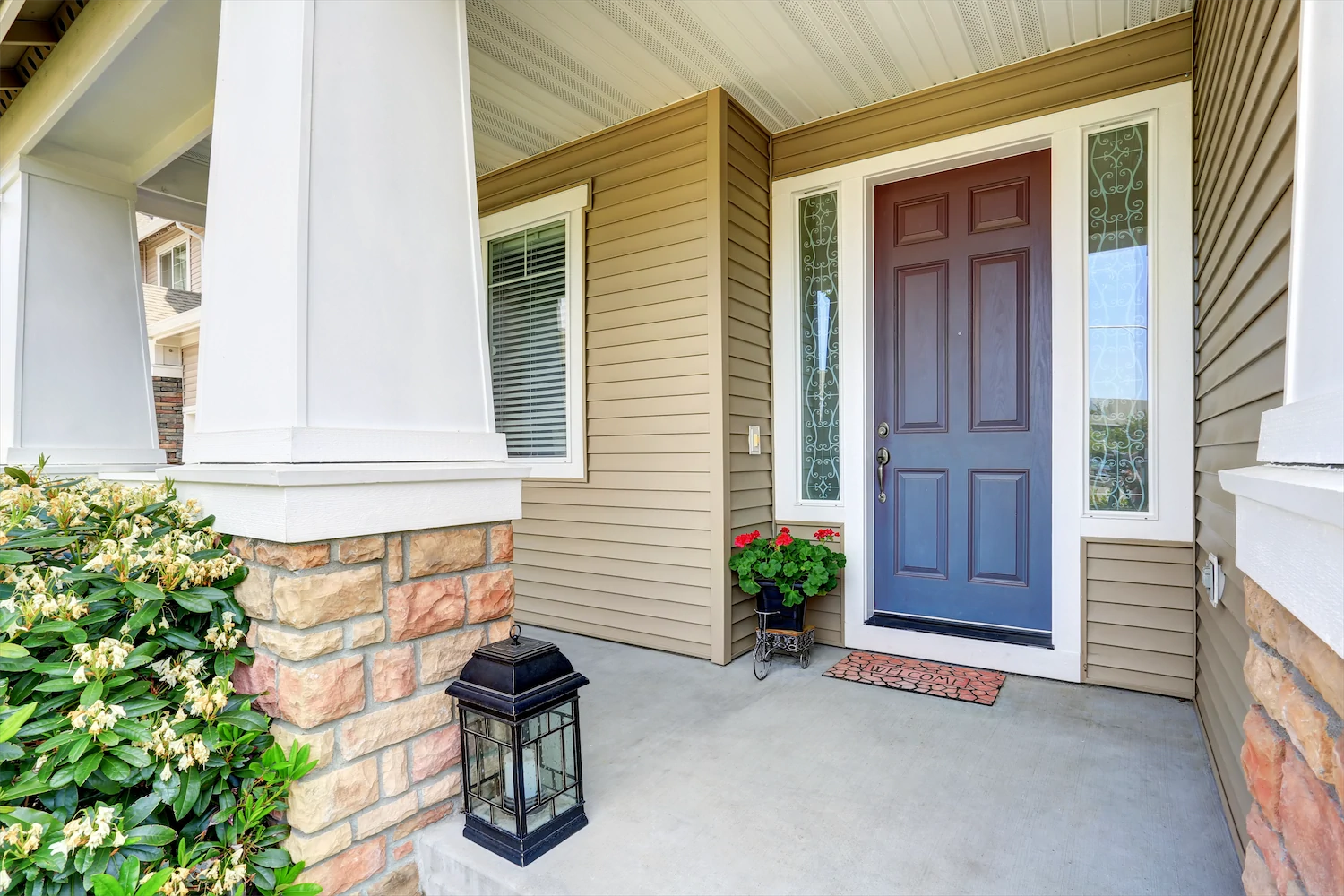
Whether you’re looking for a front door for your new home or looking to replace your existing front door, choosing the best material for your front entry door is a pivotal part of the decision process. There are three best materials for entry doors that stand out for their security, energy efficiency and maintenance: steel, vinyl and fiberglass. Take a look at why these three materials top the list.
What is the Best Material for a Front Entry Door?
The best front door material depends on your priorities. Steel offers the best value and security, fiberglass provides the longest lifespan with minimal maintenance, and vinyl delivers superior energy efficient doors at an affordable price. Wood doors offer classic beauty but require significantly more upkeep than modern alternatives.
Front Door Materials Pros and Cons Comparison
Steel Entry Doors
Steel is the leading material when it comes to affordability and one of the most durable materials available. Because of its strong build, steel doors are structurally sound and able to protect against intruders and outside elements. The material is also fire-rated and weatherproof, making them great for insulation as well.
Pros:
- Most Affordable: Lowest upfront cost among durable options
- Exceptional Security: Strongest material for break-in resistance
- Fire-Rated: Provides additional safety protection
- Energy Efficient: Insulated core creates thermal barrier
- Low Maintenance: Minimal upkeep required
- Paint-Ready: Smooth surface accepts paint beautifully
Cons:
- Denting: Can dent from hard impacts
- Difficult to Repair: Dents are challenging to fix
- Rust Potential: Scratches must be painted quickly to prevent rust
- Temperature Sensitivity: Can feel hot or cold to the touch
Because of the steel’s smooth surface, paint goes on easily and creates a clean, finished look. Alternatively, steel doors may be strong, but they are also difficult to repair if dented or scratched.
Vinyl Entry Doors
Vinyl is one of the most energy efficient and affordable materials for front doors. Their insulating properties enable them to withstand heat and cold transfer as well as insulate against wind and outdoor noise. Vinyl entry doors are also lightweight, making them easy to install and replace when necessary. This lightweight material also makes it easy to open and close the door with little to no strain.
Pros:
- Superior Energy Efficiency: Best thermal performance
- Moisture Resistant: Won’t rot, warp, or swell
- Noise Reduction: Excellent sound dampening properties
- Lightweight: Easy to operate and install
- No Painting Required: Color molded throughout material
- Wood-Look Options: Can mimic traditional wood grain patterns
Cons:
- Limited Style Options: Fewer design choices than other materials
- Color Fading: May fade over time with UV exposure
- Not Load-Bearing: Cannot support heavy decorative hardware
Vinyl can also appear like a traditional wood door, including embossed simulated wood grain patterns without the worry of wood door upkeep.
Fiberglass Entry Doors
Fiberglass doors are the premium choice for homeowners seeking the best of all worlds – durability, beauty, and performance. These doors resist warping, cracking, and deteriorating better than any other material while offering the most realistic wood-look finishes available.
Pros:
- Longest Lifespan: 30-50+ years with minimal maintenance
- Superior Durability: Resists warping, cracking, and weather damage
- Authentic Wood Look: Most realistic wood grain texture available
- Excellent Insulation: Best R-value among all door materials
- Stain or Paint: Accepts both staining and painting
- Dimensional Stability: Won’t expand or contract with temperature changes
- Best Resale Value: Highest ROI of all door materials
Cons:
- Higher Upfront Cost: More expensive initial investment than steel
- Quality Varies: Lower-end fiberglass can crack in extreme cold
- Professional Installation Recommended: More complex to install than steel
Thompson Creek fiberglass doors are manufactured from the highest quality materials, ensuring they won’t crack even in harsh Mid-Atlantic winters. Homeowners in Alexandria’s older neighborhoods often pair a new entry door with updated windows for a cohesive exterior refresh. If you’re exploring window replacement Alexandria alongside your door project, Thompson Creek handles both with a single installation team.
Wood Entry Doors
Wood is a classic front door material option, but the material has declined in popularity in recent years as other options prove to provide better security, energy efficiency and variety of style. Wood doors also require regular maintenance, where the other options require very little maintenance. Homeowners are choosing sturdier materials like steel, fiberglass and vinyl due to their durability and resistance to warping and weather damage.
Pros:
- Authentic Beauty: Genuine wood grain and character
- Traditional Appeal: Classic aesthetic for historic homes
- Customizable: Can be carved, stained, or painted
- Natural Insulator: Solid wood provides decent insulation
Cons:
- High Maintenance: Requires repainting every 3-5 years
- Moisture Damage: Expands, contracts, warps with humidity changes
- Pest Vulnerable: Susceptible to termites and wood-boring insects
- Rot and Decay: Can deteriorate without proper maintenance
- Poor Weather Resistance: Not ideal for areas with seasonal changes
- Expensive Long-Term: Maintenance costs add up over time
Wood front doors tend to expand due to moisture and heat, requiring more maintenance over the years. Wood front entry doors are also vulnerable to pests that can weaken the structure making it less energy efficient and secure. While homeowners choose the look of a wood front door, that initial appearance can alter as the paint cracks and fades over time. Most wood doors will need to be scraped, sanded and repainted every three to five years.
Although wood material is inexpensive initially, the maintenance required over the years due to wear and tear will drive this cost up. If you live in a climate with seasonal changes, wood doors are not an ideal option.
Front Door Material Cost Comparison
Understanding the complete cost picture helps you make an informed investment decision. Here’s a comprehensive breakdown of costs for each material:
| Material | Initial Cost (Installed) | Annual Maintenance | 20-Year Total Cost | Lifespan | Resale Value (ROI) |
| Steel | $800 – $1,500 | $20 – $50 | $1,200 – $2,500 | 20-30 years | 74.9% |
| Vinyl | $900 – $1,800 | $10 – $30 | $1,100 – $2,400 | 25-40 years | 68-72% |
| Fiberglass | $1,000 – $2,500 | $10 – $30 | $1,200 – $3,100 | 30-50+ years | 74.9% |
| Wood | $1,500 – $3,500 | $150 – $300 | $4,500 – $9,500 | 20-30 years | 60-65% |
Key Insights:
- While wood doors may seem affordable initially, the 20-year maintenance costs make them the most expensive option
- Fiberglass offers the best value over time with the longest lifespan and minimal maintenance
- Steel provides the best combination of upfront affordability and long-term durability
- Vinyl delivers the lowest maintenance costs while providing excellent energy efficiency
Hidden Costs to Consider
Energy Savings: Energy-efficient doors can save $100-$200 annually on heating and cooling costs compared to older, poorly sealed doors. Over 20 years, that’s $2,000-$4,000 in savings that offset higher upfront costs for premium materials like fiberglass.
Replacement Frequency:
- Wood doors often need replacement after 20-25 years ($1,500-$3,500)
- Steel doors typically last 25-30 years before replacement
- Fiberglass doors can last 40-50 years, potentially eliminating replacement costs entirely
Most Durable Front Door Material
When it comes to pure durability and longevity, fiberglass is the clear winner. Fiberglass doors are four to five times stronger than wood of the same thickness and resist the common failure points that plague other materials:
Durability Rankings:
- Fiberglass (30-50+ years) – Superior resistance to weather, impact, and time
- Steel (20-30 years) – Strong and weather-resistant but can dent
- Vinyl (25-40 years) – Excellent weather resistance, moderate impact resistance
- Wood (20-30 years) – Requires constant maintenance to reach full lifespan
Best Front Door Material for Security
Security Rankings:
- Steel – Hardest to breach, solid construction resists forced entry
- Fiberglass – Four to five times stronger than wood, excellent security
- Wood (Solid Core) – Good security when properly maintained
- Vinyl – Adequate security but not as strong as steel or fiberglass
For maximum security, choose steel or fiberglass doors with:
- Solid core construction (not hollow)
- Heavy-duty deadbolt locks
- Reinforced strike plates
- Multi-point locking systems
- Secure hinges with non-removable pins
Thompson Creek doors feature advanced locking systems and reinforced frames for superior security on all steel and fiberglass models.
Energy Efficient Front Door Materials
Energy efficiency in front doors is measured by R-value (resistance to heat flow). Higher R-values mean better insulation.
Energy Efficiency Rankings:
| Material | R-Value | Energy Performance |
| Fiberglass (insulated) | R-6 to R-8 | Excellent – Best insulation |
| Steel (insulated) | R-5 to R-6 | Very Good – Strong thermal barrier |
| Vinyl (insulated) | R-5 to R-7 | Excellent – Superior thermal performance |
| Wood (1.75″ thick) | R-2 to R-3 | Fair – Adequate but gaps develop |
Key Energy Features:
- Insulated Core: Polyurethane foam provides superior insulation
- Weatherstripping: Prevents air leakage around door perimeter
- Multi-Point Locking: Compresses weatherstripping for better seal
- Low-E Glass: If door includes glass panels, Low-E coating reflects heat
Thompson Creek entry doors feature high-density foam cores and advanced weatherstripping systems that exceed energy requirements, helping lower your utility bills year-round. Built for all weather, including salt air conditions in all our service areas, Annapolis homeowners face salt air and coastal humidity that accelerates wear on both doors and windows. Combining your door upgrade with window replacement Annapolis protects the full building envelope against the region’s demanding climate.
Best Front Door Material by Climate
Your local climate should influence your material choice:
Cold Climates (Northern States, Mountain Regions)
Best Choice: Fiberglass or Steel
- Won’t warp or crack in extreme cold
- Superior insulation reduces heat loss
- Weatherstripping maintains seal in freezing temps
- Fiberglass handles freeze-thaw cycles without damage
Avoid: Wood (contracts in cold, creating gaps)
Hot & Humid Climates (Southern States, Coastal Regions)
Best Choice: Fiberglass or Vinyl
- Resists moisture, humidity, and rot
- Won’t warp or swell in humid conditions
- UV-resistant finishes prevent fading
- Excellent air conditioning retention
Avoid: Wood (expands in humidity, susceptible to rot and mold)
Moderate Climates (Mid-Atlantic, Pacific Northwest)
Best Choice: Any Material
- All materials perform well in moderate climates
- Choose based on priorities (cost, appearance, security)
- Steel and fiberglass still require less maintenance than wood
Coastal/Hurricane Zones
Best Choice: Fiberglass
- Impact-resistant construction
- Saltwater and moisture resistant
- Won’t rust or corrode like steel
- Can withstand high winds when properly installed
Low Maintenance Front Door Materials
Maintenance Requirements Ranked (Lowest to Highest):
- Fiberglass (Minimal)
- Wash with soap and water annually
- Optional: Refresh stain or paint every 10-15 years
- Total Time: 30 minutes per year
- Vinyl (Minimal)
- Wash with soap and water annually
- No painting or staining required
- Total Time: 30 minutes per year
- Steel (Low)
- Wash with soap and water annually
- Touch up paint on scratches immediately
- Repaint every 5-7 years (optional)
- Total Time: 1-2 hours per year
- Wood (High)
- Inspect and clean quarterly
- Reseal or repaint every 3-5 years
- Repair rot, cracks, and weather damage
- Total Time: 10-15 hours per year + repair costs
Best Front Door Material for Resale Value
According to Remodeling Magazine’s Cost vs. Value Report, entry door replacement consistently ranks among the top home improvements for return on investment:
ROI by Material:
- Steel Entry Door Replacement: 74.9% ROI
- Fiberglass Entry Door Replacement: 74.9% ROI
- Vinyl Entry Door Replacement: 68-72% ROI
- Wood Entry Door Replacement: 60-65% ROI
Why Steel and Fiberglass Win:
- Low maintenance appeal to buyers
- Energy efficiency reduces operating costs
- Modern appearance enhances curb appeal
- Long lifespan means no near-term replacement needed
Real estate appraisers value homes with steel and fiberglass doors higher than comparable homes with wood or vinyl doors, especially in harsh climate regions where durability matters.
Expert Recommendation: Which Material Should You Choose?
Thompson Creek experts are here to provide expert installation and ensure that your door is built and installed to last. Here’s our recommendation based on your priorities:
Choose Steel If You Want:
- Best value for your money
- Maximum security
- Contemporary or bold colored doors
- Quick, affordable upgrade
Choose Fiberglass If You Want:
- Best overall performance and longevity
- Authentic wood appearance without wood maintenance
- Maximum energy efficiency
- Best long-term investment
- Highest resale value
Choose Vinyl If You Want:
- Superior energy efficiency on a budget
- Absolutely zero maintenance
- Excellent moisture resistance
- Quiet, noise-dampening performance
Avoid Wood Unless:
- You have a historic home requiring authentic materials
- You’re willing to commit to intensive maintenance
- You have a covered, protected entry that shields the door from weather
Why Choose Thompson Creek for Your Entry Door?
At Thompson Creek, we custom-manufacture premium steel and fiberglass entry doors designed specifically for Mid-Atlantic climate conditions. Every door includes:
- 50-Year Warranty – Industry-leading protection for your investment
- Custom Fit – Manufactured to your exact specifications
- Professional Installation – Expert crews ensure perfect fit and performance
- Energy Efficiency – Exceed ENERGY STAR requirements
- 16 Designer Colors – Customize to match your home’s style
- Advanced Security – Multi-point locking systems standard
- No Middleman Markup – Factory-direct savings
View our front door options or contact us for professional advice on buying or replacing your front door. Get your free, no-obligation consultation today and discover why thousands of Mid-Atlantic homeowners trust Thompson Creek for their entry door replacement.
Ready to upgrade your front door? Contact Thompson Creek today for a free consultation and quote. Our experts will help you choose the perfect material for your home, style, and budget.