The five main types of casement windows are: traditional side-hinged casements (left or right-hand), French casements (paired sashes without center post), awning windows (top-hinged), hopper windows (bottom-hinged), and combination configurations (fixed and operable units). Each type offers distinct advantages for ventilation, weather protection, and architectural style. Thompson Creek custom-manufactures all casement types in our Maryland facility, backed by our 50-year warranty.
Casement windows give Maryland homeowners versatility and energy efficiency that double-hung windows can’t match. Unlike traditional double-hung windows, casements open outward on hinges, providing unobstructed views, superior ventilation, and tighter seals that dramatically reduce air infiltration.
Understanding the different types of casement windows helps you choose the best option for your home’s architecture, climate challenges, and functional needs. From traditional side-hinged designs to specialized configurations, modern casement windows offer solutions for virtually any application.
What Makes Casement Windows Unique
Casement windows operate with a crank mechanism that swings the sash outward from one side. This design creates several advantages:
- Superior energy efficiency: When closed, casements compress weatherstripping across the entire perimeter, creating an airtight seal. The Department of Energy notes that casement windows typically outperform other operable window types for air leakage prevention.
- Maximum ventilation: Casements open completely, catching breezes and directing airflow into your home (unlike sliders that only open halfway).
- Unobstructed views: Without a central rail dividing the glass, casements maximize sight lines and natural light.
- Easy operation: The crank mechanism requires minimal effort, making casements ideal for hard-to-reach locations or aging-in-place modifications.
- Enhanced security: Multi-point locking systems standard on quality casements provide superior protection compared to traditional sash locks.
Traditional Side-Hinged Casement Windows
The most common casement configuration features hinges on one vertical side, allowing the window to swing outward like a door. Side-hinged casements come in left or right-hand configurations depending on hinge placement.
Left-Hand vs. Right-Hand Casements
Left-hand casement: Hinges on the left side, opens to the right. Ideal when you want to catch prevailing winds from the left or when room layout requires the sash to swing in a specific direction.
Right-hand casement: Hinges on the right side, opens to the left. Best for areas where air circulation patterns or furniture placement favor a leftward swing.
Many installations use paired casements with hinges on opposite sides, creating a symmetrical appearance while maximizing ventilation from both directions. Thompson Creek’s custom replacement windows can be configured in any combination to match your home’s needs.
Operating Mechanisms
Crank-out casements: The standard configuration uses a gear-driven crank handle. Good cranks glide open smoothly (you shouldn’t have to muscle them) and hold their position even in wind. Stainless steel gears resist corrosion in Maryland’s humid climate.
Push-out casements: Some European-style casements use friction hinges that allow manual opening without cranks. These work well for frequently accessed windows where the streamlined appearance matters more than the leverage advantage of cranks.
French Casement Windows
French casement windows pair two side-hinged sashes without a center mullion or post. When both sashes open, they create a completely unobstructed opening perfect for Mid-Atlantic homes where cross-ventilation matters during spring and fall.
Key advantages of French casements:
- Panoramic views when closed, with no center obstruction
- Wide opening for moving furniture or emergency egress
- Architectural elegance reminiscent of European design
- Versatile operation allowing one or both sashes to open as needed
French casements require careful coordination of the locking system. One sash incorporates flush bolts that secure it top and bottom, while the other sash locks to it. Quality installations ensure both sashes seal tightly despite the absence of a fixed mullion.
For Maryland homes with traditional or contemporary architecture, French casements add sophistication while delivering modern energy efficiency. Our energy-efficient windows include French casement options custom-manufactured to your specifications.
Awning Windows (Top-Hinged Casements)
Awning windows are essentially casements hinged at the top rather than the side. They open outward and upward, creating a protective “awning” that sheds rain while allowing ventilation. This is a significant advantage in Mid-Atlantic weather.
Picture this: It’s raining, but you still want that fresh air. Awning windows let you crack them open without turning your bathroom into a shower.
When Awning Windows Excel
Bathroom and basement installations: Awning windows provide privacy while maintaining ventilation, perfect for spaces where side-hinged windows would be impractical.
Weather protection: The outward-and-upward operation allows you to keep windows open during light rain, unlike double-hung windows that let precipitation enter.
Stack configurations: Multiple awning windows stacked vertically create dramatic light and ventilation in contemporary designs.
Above doors: Awning windows above entry doors provide natural light and fresh air without compromising wall space.
Awning windows work particularly well in coastal Maryland areas where afternoon rain showers are common but homeowners still want natural ventilation. The protective angle prevents water infiltration while maintaining airflow.
Hopper Windows (Bottom-Hinged Casements)
Hopper windows hinge at the bottom and tilt inward, making them ideal for specific applications where other casement types don’t fit:
Basement windows: Hopper windows in below-grade applications provide excellent ventilation and easy cleaning from inside.
Small bathroom windows: The inward tilt allows ventilation without sacrificing privacy or creating exterior protrusions.
Accent windows: Hoppers work well as decorative accent windows in combination with larger fixed or operating units.
Tight clearance areas: Where exterior obstructions prevent outward opening, hoppers provide an operating solution.
Keep in mind: hopper windows don’t work well where rain could blow in through the inward-opening sash. They’re best suited for protected locations or climates where open windows during precipitation isn’t necessary.
Combination Casement Configurations
Modern window design often combines casement types with fixed windows to create custom configurations that maximize both light and ventilation.
Picture Window with Flanking Casements
This popular configuration features a large fixed center window with operable casements on one or both sides. Benefits include:
- Maximum natural light through the expansive center panel
- Energy efficiency from the fixed center (no operating mechanisms to leak air)
- Ventilation from side casements positioned to catch prevailing breezes
- Architectural balance creating symmetrical facades
Thompson Creek manufactures these combinations as unified units, ensuring consistent appearance and coordinated flashing for complete weather protection.
Transom Awning Above Fixed Windows
Tall window assemblies often incorporate awning windows in the upper portion above fixed glass. This configuration provides:
- High ventilation that exhausts warm air without floor-level drafts
- Enhanced natural light from the increased window height
- Privacy by placing operable windows above sight lines
- Flexibility to ventilate without exposing lower living spaces
Casement and Awning Combinations
Pairing side-hinged casements with top-hinged awnings creates versatile ventilation patterns. Maryland homeowners use this approach to:
- Capture cross-breezes from multiple directions
- Stack windows vertically for contemporary aesthetics
- Separate ventilation zones (awning for steady background airflow, casement for maximum cross-ventilation)
Casement Window Types: Quick Comparison
| Window Type | Best For | Ventilation | Rain Protection | Typical Uses |
| Side Casement | Living rooms, bedrooms | Excellent | Moderate | Primary living spaces |
| French Casement | Panoramic views | Maximum | Moderate | Wide openings, architectural statements |
| Awning | Bathrooms, basements | Good | Excellent | Weather-protected ventilation |
| Hopper | Below-grade spaces | Good | Poor | Basement windows, tight clearances |
| Picture + Casement | Large wall openings | Good | Excellent | Balanced light and air |
Casement Window Materials and Construction
Material choice significantly impacts casement window performance, maintenance requirements, and longevity in Mid-Atlantic climates.
Vinyl Casement Windows
Vinyl dominates the casement market for good reasons:
- Low maintenance: Never needs painting, resists moisture and UV damage
- Energy efficiency: Multi-chamber construction creates superior insulation
- Cost-effective: Best performance-to-price ratio for most applications
- Durability: Quality vinyl formulated for extreme temperatures lasts 30+ years
- Color stability: Modern vinyl resists fading even in direct sun exposure
Thompson Creek manufactures vinyl casement windows specifically engineered for Mid-Atlantic weather. Our vinyl formulation withstands temperature extremes from sub-zero winters to 95°F+ summers without warping or becoming brittle.
Fiberglass Casement Windows
Fiberglass offers premium performance characteristics:
- Strength: Superior structural integrity allows larger sizes
- Stability: Minimal expansion/contraction with temperature changes
- Paintability: Can be painted if desired, though not necessary
- Longevity: 40+ year lifespan with minimal maintenance
Fiberglass costs more than vinyl but excels in coastal Maryland applications where salt air and hurricane conditions demand maximum durability.
Wood and Wood-Clad Casement Windows
Wood casements provide traditional aesthetics with modern performance when properly maintained:
- Authentic appearance: Irreplaceable for historic home renovations
- Insulation value: Wood’s natural properties enhance thermal performance
- Customization: Can be stained or painted to match any décor
Wood-clad casements combine wood interiors with vinyl or aluminum exteriors, delivering traditional interior beauty with weather-resistant exteriors that require minimal maintenance.
Energy Efficiency Features in Modern Casement Windows
Not all casement windows deliver equal energy performance. Look for these features when comparing options:
ENERGY STAR® Certification
ENERGY STAR® certified casements meet strict thermal performance criteria established by the Department of Energy and EPA. For Mid-Atlantic homes, this means:
- U-Factor: 0.30 or lower (measures heat transfer resistance)
- Solar Heat Gain Coefficient: 0.25 or lower (controls solar heat entry)
Thompson Creek’s casement windows exceed 2022 ENERGY STAR® criteria, ensuring maximum energy savings year-round.
Low-E Glass Coatings
Low-emissivity coatings reflect infrared light, reducing heat transfer without blocking visible light. Benefits include:
- Lower cooling costs: Reflects summer heat away from your home
- Reduced heating costs: Reflects interior heat back inside during winter
- UV protection: Prevents fading of furniture and flooring
- Improved comfort: Eliminates hot and cold spots near windows
Gas Fills
Argon or krypton gas between window panes insulates better than air:
- Argon fill: Standard in quality double-pane windows, improves insulation 15-20%
- Krypton fill: Used in triple-pane or tight-spacing applications, 30% better than argon
Multi-Point Locking Systems
Advanced casement locks engage the frame at multiple points, creating:
- Tighter seals: Compression across the entire sash perimeter
- Enhanced security: Multiple engagement points resist forced entry
- Reduced air infiltration: Even pressure distribution prevents gaps
Proper Casement Window Installation and Flashing
Even the highest-quality casement windows fail when improperly installed. Professional installation ensures decades of reliable performance.
Critical Installation Factors
Flashing integration: Casement windows require meticulous window flashing that accommodates the outward-opening sash. Water must drain properly around hinges and locks.
Square and plumb: Casement frames must be perfectly square. Even slight distortion prevents proper closing and creates operational problems.
Proper shimming: Frames need support at specific intervals to prevent sagging that binds operating mechanisms.
Weatherstripping alignment: Compression weatherstripping must contact consistently around the entire perimeter when the window closes.
Poor window installation manifests quickly with casements. Windows that won’t close tightly, cranks that bind, or water infiltration around the frame all indicate installation problems.
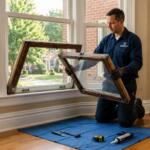
Thompson Creek’s factory-trained installers understand casement-specific requirements. We install thousands of casement windows annually across Maryland, Virginia, and DC, backing every installation with our 50-year No-Hassle Warranty.
Choosing the Right Casement Window Type for Your Home
Consider these factors when selecting casement windows:
Architectural Style
Traditional homes: Wood or wood-clad casements with divided lite patterns maintain historic character
Contemporary designs: Clean-lined vinyl or fiberglass casements with minimal grids maximize modern aesthetics
Colonial or Cape Cod: Paired casements flanking fixed centers echo classic proportions
Functional Requirements
Maximum ventilation: French casements or wide single casements capture the most airflow
Weather protection: Awning windows allow ventilation during rain
Easy operation: Crank-out mechanisms work best for hard-to-reach locations
Emergency egress: Bedroom casements must meet code requirements for opening size and operation
Location Considerations
Coastal Maryland: Fiberglass or premium vinyl for salt air resistance, impact-rated glass for storm protection
Urban areas: Multi-point locks provide enhanced security
Rural settings: Wide casements capture prevailing breezes for natural cooling
Shaded locations: Casements with larger glass areas maximize limited light
Why Choose Thompson Creek for Casement Windows
Thompson Creek has manufactured and installed custom casement windows for Mid-Atlantic homeowners since 1980. We understand regional challenges from coastal storms to temperature extremes.
What sets our casement windows apart:
- Custom manufacturing in our 70,000 sq ft Maryland facility
- ENERGY STAR® certification exceeding 2022 criteria
- AAMA testing confirming 146 mph wind resistance
- Premium operating mechanisms with stainless steel components
- 50-year No-Hassle Warranty covering both product and installation
- Professional installation by factory-trained crews
We design, build, install, and service every casement window. One company with complete accountability. No dealers, no subcontractors, no confusion about warranty coverage.
Whether you’re replacing failing windows, adding new openings, or building your dream home, Thompson Creek’s casement windows deliver the perfect combination of energy efficiency, durability, and aesthetic appeal.
Frequently Asked Questions About Casement Windows
What’s the difference between casement and awning windows?
Casement windows hinge on the side and open outward horizontally, while awning windows hinge at the top and open outward and upward. Both provide excellent ventilation, but awning windows can remain open during light rain because of their protective angle. Casements typically offer slightly better maximum airflow when fully opened.
How long do casement windows last?
Quality casement windows from manufacturers like Thompson Creek last 20-30+ years with proper maintenance. Our windows are backed by a 50-year No-Hassle Warranty covering both product and installation, providing long-term protection for your investment.
Are casement windows more energy efficient than double-hung windows?
Yes. Casement windows typically reduce air infiltration by up to 50% compared to double-hung windows because they compress weatherstripping across the entire perimeter when closed. The Department of Energy confirms that casements outperform other operable window types for preventing air leakage.
Can casement windows withstand Maryland’s severe weather?
Thompson Creek’s casement windows are AAMA-tested to withstand winds up to 146 mph, making them suitable for hurricane-prone coastal areas and severe Mid-Atlantic storms. The multi-point locking system creates a tight seal that resists both wind and water infiltration.
Do casement windows require more maintenance than other window types?
No. Modern casement windows require minimal maintenance. The crank mechanisms are sealed and self-lubricating. Simply clean the glass as needed and occasionally wipe down the weatherstripping. Quality vinyl or fiberglass casements never need painting.
What’s the average cost to replace casement windows?
Casement window replacement costs vary based on size, materials, energy efficiency features, and installation complexity. Custom-manufactured windows with professional installation provide better long-term value than stock windows. Contact Thompson Creek for a free consultation and accurate pricing for your specific needs.
Can I install casement windows myself?
While possible, professional installation is strongly recommended. Casement windows require precise squaring, proper flashing integration, and careful weatherstripping alignment to perform correctly. Improper installation voids warranties and leads to air infiltration, water damage, and operational problems.
Ready to explore casement window options for your Maryland home? Schedule a free consultation with Thompson Creek’s window experts. We’ll assess your needs, discuss configuration options, and provide detailed recommendations backed by our industry-leading warranty.