You’re standing in the window aisle at Home Depot or scrolling through contractor estimates, and you keep seeing two categories: replacement windows and new construction windows. They look similar. Sometimes they’re the same price. The descriptions sound almost identical.
So what’s the actual difference, and why does it matter for your project?
After manufacturing custom windows in our Maryland facility since 1980 and installing them across the Mid-Atlantic, Thompson Creek has guided thousands of homeowners through this exact confusion. The difference between replacement and new construction windows isn’t about quality or energy efficiency. It’s about the installation method and which type of project you’re tackling.
Choose wrong, and you’ll either overpay for unnecessary work or create problems that haunt you for years.
The Core Difference: What Gets Removed
The fundamental distinction between replacement and new construction windows comes down to how much of your existing window assembly you remove and replace.
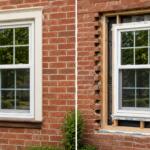
New Construction Windows replace everything: the entire window frame, the rough opening framing, exterior and interior trim, siding, and sometimes portions of wall structure. You’re starting from bare studs.
Replacement Windows work within your existing window frames. You remove the old sashes (the moving parts) but leave the original frame, exterior trim, and siding undisturbed.
Think of it like renovating a kitchen. New construction is tearing everything out to the studs and starting over. Replacement is keeping the cabinets and just swapping the doors and hardware.
When to Use Replacement Windows
Replacement windows (also called retrofit windows or insert windows) make sense in specific situations.
Existing Frames Are Structurally Sound
If your window frames show no rot, no water damage, are square and plumb, and provide solid mounting surfaces, replacement windows install quickly without disturbing siding or trim.
Thompson Creek design consultants verify frame condition during free in-home consultations. We measure for square, check moisture content, and inspect for structural issues before recommending replacement windows.
You Want Minimal Disruption
Replacement window installation doesn’t disturb siding, brick, stucco, or interior drywall. Professional crews complete installations in 1 to 2 hours per window with minimal mess.
For occupied homes, especially in Mid-Atlantic winters when you can’t leave openings exposed overnight, replacement windows offer significant advantages. Our guide on how to prepare your home for window replacement walks through exactly what installation day looks like so you know what to expect.
Exterior Aesthetics Must Be Preserved
Historic homes, unique architectural styles, or buildings in historic districts often prohibit exterior alterations. Replacement windows maintain existing exterior appearance while upgrading performance.
Annapolis, Alexandria, and Fredericksburg historic districts have strict preservation requirements. Replacement windows meet those requirements while improving energy efficiency. If you own an older home with specific character you want to preserve, our guide to replacement windows for historic and older homes covers the key considerations.
Budget Constraints Matter
Replacement windows typically cost meaningfully less than new construction installations. The savings come from reduced labor: no siding removal, no trim work, no drywall repairs. For a whole-home project, that difference adds up quickly. For a deeper breakdown of what drives pricing, see our complete window replacement cost guide and our cost guide by home type for single-family homes, townhomes, and condos.
The Trade-Off: Slightly Smaller Glass Area
Replacement windows are installed inside existing frames, reducing glass area by 1 to 2 inches per dimension. For a 36″ x 60″ window, you lose approximately 10 to 15% of the glass area.
This matters more for small windows where every inch of natural light counts. For larger windows, the difference is barely noticeable.
Thompson Creek manufactures custom replacement windows that maximize glass area within existing frames. Our narrow frame profiles deliver more daylight than standard replacement windows.
When to Use New Construction Windows
New construction windows (also called full-frame windows) are necessary or advantageous in specific situations.
Existing Frames Are Damaged or Rotted
Water damage, rot, termite damage, or structural settling compromise frame integrity. Installing replacement windows in damaged frames guarantees future problems.
Mid-Atlantic homes built before 1980 frequently have rot around windows due to poor flashing, especially on north-facing walls and in coastal areas with salt air exposure. If you’ve noticed leaking or water staining around your frames, our guide on causes and fixes for leaking windows can help you understand whether repair or full-frame replacement is the right call.
New construction installation removes damaged wood, allows proper moisture barrier installation, updates to modern flashing systems, and provides a solid mounting point for new windows.
You’re Changing Window Sizes or Locations
Want to convert two small windows into one large window? Replace a double-hung with a bay window? Add windows to existing walls? New construction windows allow complete flexibility because you’re creating or modifying rough openings. Replacement windows must work within existing frame dimensions.
Maximum Glass Area Is the Priority
New construction windows mount to the rough opening, not inside existing frames. This provides maximum glass area for any given opening size.
For small bathrooms, breakfast nooks, or rooms where natural light matters, that additional 10 to 15% glass area makes a noticeable difference.
You’re Building New or Doing Major Renovations
New construction logically calls for new construction windows. But major renovations that gut walls to the studs also make new construction windows the practical choice, even if existing frames are intact. Why install replacement windows inside old frames when you’re already exposing rough openings?
The Trade-Off: Higher Cost and More Disruption
New construction window installation costs 50 to 65% more than replacement windows due to labor intensity. Expect siding removal and replacement, exterior trim carpentry, interior drywall repairs and painting, and 3 to 4 hours of installation time per window.
For occupied homes, this creates significant disruption. Openings may be temporarily covered overnight, requiring weather protection and security measures.
Side-by-Side Comparison
| Factor | Replacement Windows | New Construction Windows |
| Existing Frame | Must be sound, square, plumb | Removed completely |
| Installation Time | 1 to 2 hours per window | 3 to 4 hours per window |
| Relative Cost | Lower | Meaningfully higher |
| Siding/Trim Work | None required | Removal and replacement |
| Interior Disruption | Minimal | Drywall work, painting |
| Glass Area | Reduced 10 to 15% | Maximum for opening |
| Weather Exposure | Minimal during install | Opening exposed during work |
| Flashing Integration | Uses existing flashing | New flashing installed |
| Best For | Sound existing frames | Damaged frames, new construction |
| Energy Performance | Identical to new construction | Identical to replacement |
| Warranty Coverage | Same as new construction | Same as replacement |
Critical Point: Both window types offer identical energy efficiency when manufactured with the same glass packages and frame materials. The difference is installation method, not performance.
Thompson Creek’s energy-efficient windows deliver the same U-factors, SHGC ratings, and air-leakage performance whether installed as replacement or new construction units.
Cost Considerations: What Drives the Difference
The cost gap between replacement and new construction installations is real, and it comes down almost entirely to labor. Replacement installations skip the siding removal, exterior trim carpentry, interior drywall repairs, and finishing work that new construction requires.
For a single window, that labor difference is noticeable. For a whole-home project, it compounds significantly. Our complete window replacement cost guide walks through what drives pricing in detail, and our Maryland window tax credits and rebates guide explains the state and federal incentives that can offset a meaningful portion of your project cost for qualifying energy-efficient installations.
Installation Method Details
Understanding exactly how each type installs helps you evaluate which makes sense for your project.
Replacement Window Installation Process
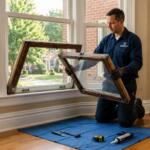
Step 1: Remove interior stops and old sashes (moving parts) while leaving the exterior frame, brick molding, and siding intact.
Step 2: Clean and prepare existing frame surfaces for sealant contact.
Step 3: Apply sealant to frame contact surfaces.
Step 4: Insert the new window unit into the existing frame opening from the interior or exterior, depending on window style.
Step 5: Shim the window square, level, and plumb within the existing frame.
Step 6: Secure the window through pre-drilled mounting holes into the existing frame.
Step 7: Insulate gaps between the new window and existing frame with low-expansion foam.
Step 8: Apply exterior sealant and interior trim.
Total time: 1 to 2 hours per window for experienced installers. For a detailed step-by-step walkthrough of the installation sequence, see our guide on how replacement windows are installed.
Thompson Creek’s professional installation crews complete replacement window installations efficiently because they install our custom-manufactured windows every day.
New Construction Window Installation Process
Step 1: Remove the entire existing window assembly, including frame, brick molding, and adjacent siding.
Step 2: Inspect and repair rough opening framing (address any rot, damage, or out-of-square conditions).
Step 3: Install a modern flashing system that integrates with the weather barrier and siding.
Step 4: Set the new window unit into the rough opening and attach nailing flanges to exterior sheathing.
Step 5: Shim the window square, level, and plumb within the rough opening.
Step 6: Insulate gaps between the window unit and rough opening.
Step 7: Reinstall or replace siding around the window.
Step 8: Install exterior trim (brick molding and casing).
Step 9: Install interior trim and finish drywall returns.
Total time: 3 to 4 hours per window for experienced installers, longer if rough opening repairs are needed.
Frame Condition: The Decision Factor
The condition of your existing window frames determines which window type makes sense. Here’s how to evaluate yours.
Your windows often show the warning signs before things get serious. Our post on five things your windows are trying to tell you covers the most common signals homeowners miss, from drafts and condensation to water staining and frame deterioration.
Signs Your Frames Are Good Candidates for Replacement Windows
- Solid wood with no soft spots or rot
- Square corners (diagonal measurements equal within 1/4 inch)
- Plumb jambs (vertical sides are truly vertical)
- Level sill (horizontal bottom is truly horizontal)
- No water stains or previous leak evidence
- Paint and caulk in reasonable condition
- Firm attachment to wall structure
Signs You Need New Construction Windows
- Soft, punky wood indicating rot
- Visible water damage or staining
- Out-of-square openings (more than 1/2 inch variation)
- Noticeable gaps between frame and wall
- Previous amateur repairs or modifications
- Cracked or damaged frame members
- Evidence of termite or insect damage
- Frame members flexing when pressed
For a complete checklist of what to look for during your own inspection, our guide on how to tell if windows are energy efficient walks through frame integrity, seal condition, and other performance indicators in detail.
Mid-Atlantic Specific Concern: Coastal areas like Virginia Beach, Annapolis, and Ocean City see accelerated rot due to salt air and humidity. Homes built between the 1960s and 1980s often used lower-grade lumber that’s particularly susceptible to decay.
Thompson Creek design consultants perform thorough frame inspections during consultations. If we find conditions that require new construction installation, we explain exactly what we found and why replacement windows won’t hold up.
Energy Efficiency Considerations
This is where homeowner confusion peaks: “Are new construction windows more energy-efficient than replacement windows?”
The short answer is no. Energy efficiency depends on glass package, frame materials, weatherstripping quality, and installation quality. Not whether the window is a replacement or a new construction configuration.
What Determines Energy Efficiency
Glass Package:
- Low-E coatings controlling heat transfer
- Argon or krypton gas fills the space between panes
- Number of panes (double vs. triple)
- Spacer systems separating panes
- Visible transmittance for daylight
Frame Materials:
- Vinyl with multi-chamber designs
- Fiberglass with low thermal conductivity
- Wood with natural insulating properties
- Proper weatherstripping and seals
Installation Quality:
- Proper air sealing with foam and sealant
- Correct flashing directing water away
- Square, level, plumb installation
- Appropriate shimming without distortion
Thompson Creek manufactures both replacement and new construction windows with identical glass packages and frame construction. A replacement window achieves the same U-factor (0.24 to 0.28) and SHGC (0.25 to 0.35) as a new construction window built to the same specifications.
For a full breakdown of what these ratings mean for your home and how to choose the right glass package, see our guides on how to choose energy-efficient windows and the benefits of energy-efficient windows. If you want to understand why energy-efficient windows are worth the investment in dollars and comfort, our post on why energy-efficient windows are a smart investment lays out the case in detail.
Where New Construction Provides Energy Advantages
New construction installation allows complete flashing integration with modern weather barriers, addresses thermal bridging around rough openings, enables insulation upgrades during wall exposure, and creates continuous air barriers.
These advantages come from the installation process, not the window itself. If your existing frames are well-sealed and properly flashed, replacement windows achieve equivalent performance.
Warranty Considerations
Both window types should carry identical warranty coverage from the manufacturer. The difference is what’s covered under installation warranties.
Replacement Window Installation Warranty covers:
- Proper fit within existing frames
- Air and water infiltration at new seals
- Operational issues from installation
- Interior trim and finish work
New Construction Installation Warranty covers everything in the replacement warranty, plus:
- Siding integration and water management
- Rough opening modifications and repairs
- Flashing system performance
- Exterior and interior trim work
Thompson Creek’s 50-year No-Hassle Warranty covers both materials and installation labor for up to 50 years, regardless of whether we install replacement or new construction windows.
Because we manufacture windows in our Maryland facility and install them with our own crews, we control quality at every step. No finger-pointing between manufacturers and installers.
Making Your Decision: A Decision Tree
Work through these questions to determine which window type your project actually requires.
Question 1: Are you building new or gutting to studs?
- Yes: New construction windows (clear-cut choice)
- No: Continue to Question 2
Question 2: Do your existing frames show rot, damage, or structural issues?
- Yes: New construction windows (necessary)
- No: Continue to Question 3
Question 3: Are you changing window sizes or locations?
- Yes: New construction windows (only option)
- No: Continue to Question 4
Question 4: Is maximizing glass area critical for your situation?
- Yes: Consider new construction windows
- No: Continue to Question 5
Question 5: Is your budget tight or is minimizing disruption important?
- Yes: Replacement windows (best choice)
- No: Either type works; replacement usually makes more sense
Question 6: Are there historic preservation requirements?
- Yes: Replacement windows (likely required)
- No: Replacement windows recommended for cost and efficiency
Common Misconceptions Debunked
Myth #1: “New construction windows are higher quality”
Not true. Both types are manufactured to identical quality standards. Many manufacturers build the same window in both replacement and new construction configurations using identical materials.
Myth #2: “Replacement windows don’t last as long”
Not true. Lifespan depends on materials, manufacturing quality, and installation, not installation method. Quality replacement windows last 30 to 50+ years.
Myth #3: “New construction windows are always more energy efficient”
Not true. Energy efficiency is determined by glass package and frame construction, which can be identical between types.
Myth #4: “Replacement windows look cheap from outside”
Not with quality windows. Thompson Creek’s narrow frame profiles and professional installation create a clean exterior appearance that maintains your home’s aesthetics.
Myth #5: “I should always use new construction when possible”
Not true. Paying 50 to 65% more for new construction installation when replacement windows would work perfectly is money you don’t need to spend.
The Thompson Creek Recommendation Process
Here’s how we help homeowners make the right call.
Step 1: Free In-Home Consultation
Our design consultants inspect your existing windows, measure rough openings and frame dimensions, test for square, level, and plumb, check for rot, damage, or structural issues, and discuss your goals and priorities.
Step 2: Honest Assessment
We tell you straight up whether replacement windows will work for your situation. If we find frame damage, out-of-square conditions, or other issues requiring new construction, we explain exactly what we found and why.
Step 3: Custom Recommendations
We recommend the most cost-effective solution that achieves your goals. Sometimes that’s all replacement windows. Sometimes it’s mostly replacement with a few new construction installations where frames are damaged. Sometimes it’s all new construction.
Step 4: Detailed Proposals
We provide written quotes detailing window specifications, installation methods, project timeline, and warranty coverage. No surprises, no hidden costs.
Step 5: Expert Installation
Our factory-trained crews install windows using proven techniques developed over 40+ years. We handle everything from old window removal to final cleanup.
Frequently Asked Questions
Can I mix replacement and new construction windows in the same project?
Yes. It’s common to use replacement windows where frames are sound and new construction windows where frames need replacing. Thompson Creek frequently provides mixed installations, matching the right window type to each opening’s condition.
Do replacement windows reduce home value compared to new construction?
No. Home value depends on overall window quality, energy efficiency, and aesthetics, not installation method. Quality replacement windows increase home value just as effectively as new construction installations.
How do I know if my existing frames are good enough for replacement windows?
Professional inspection is the only reliable method. Thompson Creek provides free consultations that include thorough frame inspection. We measure for square, check for rot using moisture meters and probes, and verify structural integrity. Not sure what questions to bring to that consultation? Our post on questions to ask about replacement windows gives you a solid starting list.
Are there situations where replacement windows won’t work even with good frames?
Yes. If you’re changing window sizes, converting window styles that require different rough openings, or adding windows to existing walls, you need new construction windows regardless of existing frame condition.
Will replacement windows leak more than new construction?
No, when properly installed. Water infiltration depends on installation quality, not window type. Proper sealant application, flashing integration, and air sealing prevent leaks with both installation methods.
Can I install replacement windows myself but not new construction windows?
DIY replacement window installation is difficult but possible for experienced homeowners. That said, precision measuring, proper air sealing, and warranty coverage all argue for professional installation. Our post on whether you should install replacement windows yourself walks through the real trade-offs honestly. DIY new construction installation requires advanced carpentry skills, siding expertise, and building science knowledge beyond most homeowner capabilities.
Get Expert Guidance Choosing the Right Windows
Thompson Creek has helped thousands of Mid-Atlantic homeowners navigate the replacement versus new construction decision since 1980. We’ll inspect your frames, explain your options honestly, and recommend the most cost-effective solution for your situation.
You get:
- Free in-home consultation with thorough frame inspection
- Honest assessment of whether replacement windows will work
- Custom-manufactured windows from our Maryland facility
- Professional installation by factory-trained crews
- 50-year No-Hassle Warranty covering materials and installation
- Complete project management from consultation through final walkthrough
Schedule your free window consultation or call to discuss your project.